Guidelines on Use of Riser Ducts by In-Building Terrestrial Telecommunication System Licensee
1. Telecom riser ducts are reserved for exclusive use by Public Telecommunication Licensees (PTLs) and Telecommunication Service Licensees (TSLs) referred to as FBOs, who provide fixed services to buildings. Any other party who use the riser ducts shall seek permission from IDA.
2. These guidelines are applicable to In-Building Terrestrial Telecommunication System Licensee (IBTSL) who are required to apply to IDA to lay cables in telecom riser ducts of commercial buildings or within the telecom conduits of HDB's Electrical and Telecom (E&T) riser ducts. In some HDB estates, telecom conduits run vertically through floors as metal or wood trunking or as uPVC pipes and not located within E & T riser ducts.
Figure 1
|
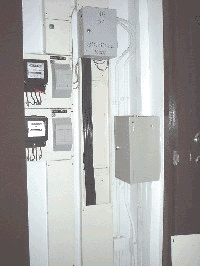
Figure 2
|
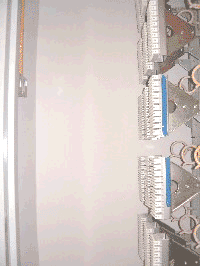
Figure 3
|
Figure 1 and 2 show typical Telecom Conduits in HDB E&T Riser Duct. Figure 2 shows the conduit with the cover removed to expose the cables.
Figure 3 shows the Telecom Conduit in commercial, industrial, and high-rise residential unit
|
3. IBTSL are required to write to IDA to seek approval each time telecom riser ducts or conduits are to be used. These conduits can be constructed of metal (Figure 1) or of other material like wood or plastic.
4. Before applying to IDA for use of riser ducts or conduits, an IBTSL is required to first explore other possibilities of using other facilities.
5. Approval for use of riser space will be granted on a case-by-case basis and on the availability of space in the riser or within the conduit. Where installing cables in conduits is concerned, the total cross-sectional area of the cables and ancillary devices and joints shall not exceed 10% of the cross-sectional area of the conduit (see figure 4).
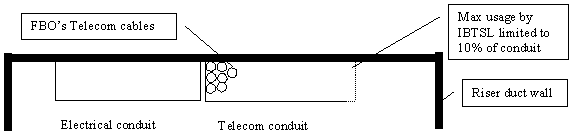
Figure 4 - Cross-section (plan view) of a typical E&T riser duct in modern HDB Estates.
6. Upon obtaining IDA's approval, an IBTSL is advised to consult building owners or in the case of HDB estates, HDB and/or Town Councils to gain access to and carry out installation in riser ducts.
7. When applying for approval to use a riser duct or a conduit, an IBTSL is required to provide the following information:
7.1. Details of the proposed installation work, including the quantity and sizes of cables; proposed cable position in the rise; the network configuration drawing indicating the segments of cables which will be installed within the riser ducts or conduits;
7.2. Pictures (preferably soft copies) of the riser ducts indicating the dimensions of the risers, sizes of cable trays/conduits and the proposed cable locations. Pictures submitted should indicate the lowest, highest and a floor in between (most congested) where the cable is intended to run through;
7.3. Where pictures mentioned in paragraph 7.2 are not available, the applicant must provide existing layout plans of the riser/s with measurements indicating the proposed cable location; and
7.4. Where installations are carried out in multiple telecom riser ducts or conduits, the IBTSL is required to submit a typical floor plan showing in totality the number of installations and to indicate each installation with "X"s.
8. An IBTSL who has been approved to install cables in a riser duct or a conduit is required to:
8.1. Provide a separate cable tray or metal/plastic (PVC) trunking to house cables in the riser ducts of commercial buildings. Where cables are to be installed within conduits in HDB estates, the cables shall be installed with no encasement.
8.2. Clearly mark all of their installation and own cables installed for easy identification of owners. The labels or markings shall be made of durable material and shall be fasten properly or imprinted/embossed on the cables;
8.3. Ensure that no active devices are installed in the riser ducts;
8.4. Ensure that all cables are properly tied to the cable tray and neatly laid. All such cables shall be laid in such a way that it will not obstruct work space of other users or become a safety hazard;
8.5. Ensure that all floor opening holes are sealed according to the IDA COPIF technical requirements when punching through floors during the laying of cables; and
8.6. Ensure proper housekeeping after completion of the works.
8.7. Provide upon completion of works, pictures of the installation in the riser or conduit (as the case may be). The submission of these pictures shall be in A4 paper and shall:
8.7.1. Indicate the building name and the floor the picture was taken;
8.7.2. Capture the dates the photographs were taken;
8.7.3. Indicate/identify the Licensee's cables and supporting structures for the cables and highlight the distinguishing markings; and
8.7.4. Indicate the point of entry and exit in the floor opening.
9. Where necessary, IDA may require a joint site survey with an IBTSL to ensure that all requirements of IDA are complied with.
10. When a riser duct or conduit has been fully utilised and it is not feasible to accommodate lying of additional cables, IDA may refuse access to or installation of any cables in the riser or conduit, notwithstanding the IBTSL has satisfied the requirement as stated in paragraphs 3,4, 5 or 6.
11. Where the IBTSL has been permitted by IDA to use the riser duct or conduit and the usage has impeded the laying of cables and other support structures by an FBO, IDA may require the IBTSL to make the necessary alteration or adjustment to its installation at its own cost to accommodate the requirement of the FBO. In the event that such alternation or adjustment is not feasible, IDA may require the IBTSL to remove its installation at its own cost to make way for the installation by the FBO.
12. When an FBO's laying of cables or other support structures in the riser duct or conduit is impeded by cables already installed in the riser by the IBTSL without IDA's approval, IDA will require the IBTSL to remove the cables. The cost of such removal shall be borne by the IBTSL who shall also undertake to indemnify IDA of all liabilities that may arise therefrom.
13. An IBTSL who is no longer operating in the building and where cables laid are still in use by other parties, shall not remove any part of the cables or cabling support structures from the riser duct or conduit without IDA's approval.
14. Where the cables laid by the IBTSL are no longer in use and there are no other parties interested in taking over ownership of the cables, the IBTSL must recover the cables and the support structures at its own cost from the riser duct or conduit and inform IDA of such removal.
15. These guidelines are subject to review from time to time by IDA to take account of changes of regulatory environment and policy.
Any enquiry or application for the use of risers is to be forwarded to:
Director, Interconnection & Access
Infocomm Development Authority of Singapore
10 Pasir Panjang Road
#10-01 Mapletree Business City
Singapore 117438
Fax: +65 62112116
Email:
a)
[email protected]
b)
[email protected]
Updated as of 16 June 2004