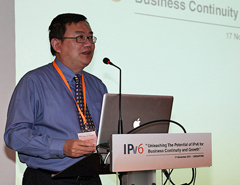
Mr. Leong Keng Thai, Deputy Chief Executive and Director-General (Telecoms and Post) of IDA, speaking at the opening of "Unleashing The Potential of IPv6 for Business Continuity and Growth" executive briefing.
|
Begin to leverage the benefits and opportunities of IPv6 (Internet Protocol version 6) now! This was the key and urgent message communicated at the Infocomm Development Authority’s of Singapore (IDA) "Unleashing the Potential of IPv6 for Business Continuity and Growth" executive briefing on 17 Nov 2011 at Hotel Fort Canning in Singapore.
The Internet has transformed the world, growing over the past 30 years into a burgeoning network that connects some 840 million hosts and over 2 billion users all around the globe. However, IPv4 (Internet Protocol version 4) addresses have run out, and in order for the Internet to continue sustaining its growth, IPv6 is needed.
Preparing for the Next Generation
Singapore sees the importance of IPv6 and IDA is the government agency tasked with catalysing the local business community to leverage the potential of IPv6 and prepare for the next phase of Internet growth.
"With the explosive growth in mobile devices including wireless handheld devices, the increasing popularity of cloud computing and the emergence of the ‘Internet Of Things’, which connects everything like appliances and vehicles to the Internet, the need for IP addresses becomes even more prevalent," said Leong Keng Thai, Deputy Chief Executive/Director-General (Telecoms & Post), IDA. "Given that the Internet is now part and parcel of many businesses and the accelerating rate of globalisation, business growth will inevitably be impacted should there be a shortage of Internet addresses."
Urgency in Asia
While the exhaustion of IPv4 addresses is a global phenomenon, the need for IPv6 is even more urgent in Asia where economic growth is quickest.
"There are zero blocks of IPv4 addresses left in Asia, yet it has used the most IPv4 addresses over the past year," said Tony Hill, Chair of Asia Pacific IPv6 Task Force, which assists in IPv6 production-level deployment and promotion of economies in the Asia Pacific region. "With 60 percent of the world’s population and housing the majority of global growth, IPv6 is primarily Asia’s problem."
In addition, an Organisation for Economic Co-operation and Development (OECD) report in 2007 noted that the only sustainable solution that can deliver economic and social opportunities for the future of the Internet economy is IPv6.
Even in the short to medium term, it makes business sense for companies in Singapore and Asia to aggressively ensure IPv6 capability in their Internet strategies. "Since 2000, many of the major trading nations like Japan, Korea, China, Australia, US, Europe and India have embarked on IPv6 roadmaps," said Hill. "Many of their deadlines for readiness are set for next year!"
With recent economic turmoil in U.S. and Europe, banks and businesses are shifting their focus to tap into the growth of Internet economies powered by rising Asian economies. It thus becomes imperative that these companies themselves are ready to efficiently handle IPv6 traffic.
Innovation Foundation
Beyond geographical reach, IPv6 also represents the foundation for next generation Internet innovation.
"IPv6 capabilities are the advent of new customer categories such as healthcare, automotive, gaming, Internet of things, and sensor networks," said Yew Hock Meng, Chief Marketing Officer, LGA. "There is already a growing demand for peer-to-peer mobile applications and interest in sensor device applications to capture data from remote locations." LGA is an Internet and communications service provider in Singapore and one of its key competitive differentiators is to ensure that it stays ahead of the technology curve. The company is one of the first in Singapore ready to handle IPv6 traffic for itself and its customers. "It took us three years to reach this stage where we are completely IPv6 ready," noted Yew. "Starting early has given us a headstart, afforded us significant visibility, and allowed us to differentiate ourselves in the market."
Ensuring access to IPv6 traffic also means that businesses can readily tap the social and synergistic power of human collaboration, according to Cyrus Daruwala, Managing Director, Asia/Pacific of research company IDC Financial Insights "Banks, insurance firms, securities firms and even exchanges have started to embrace the power of Web 3.0, social media and real-time business intelligence on the mobile. Majority of these initiatives avail of the power of next generation Web 3.0 - and all of its collaborative tools. For the consumer to be able to access these collaborative social media tools (and applications), and for the financial service industry to provide these tools to their customers - they have to be on a scalable, secure and standardized IP platform. This makes it practically mandatory for the financial institutes, their telecom providers and IT vendors to embrace IPv6 - collectively. An isolated approach to IPv6 does not serve the purposes as it causes an inter-operability issue."
Customer Demand
For Matrix Networks, which owns an undersea fibre optics cable system between Singapore and Indonesia, IPv6 implementation was borne out of a need to ensure its customers had the flexibility to deploy IPv6 services. "We operate in the wholesale market and our customers are Tier 1 telecom service providers, Internet service providers and multinational companies," said Willy Sutrisno, Head of Provision, Matrix Networks. The need to meet the demands of such high profile clients drove Matrix Networks towards early implementation of IPv6. "We are the only organisation in Singapore at the moment that has end-to-end IPv6 capability covering the local area network, wide area network, as well as our internal servers."
This same motivation to ensure that customer demands are met also drove NTT Communications to early adoption of IPv6. The company is the biggest managed service provider in Asia supporting global network services. Serving hundreds of thousands of businesses and hundreds of millions of individuals, NTT Communications was strongly motivated to get its infrastructure IPv6 ready. "Enterprises need to have a scalable network for business expansion," said Hirokazu Takahashi, Senior Manager, NTT Communications. "Whether it is for business to business or business to consumer, we have to prepare for customer demand." Because of its scale of operations, the company began its IPv6 transition as early as 1999, and now operates a fully redundant and fully IPv4/6 dual stack network.
Intrinsic Benefits
Even while the abounding business and innovation opportunities alone are reason enough for companies to make a quick transition to IPv6 capable IT infrastructure, IPv6 implementation brings much more to the table including increased security and ease of management.
"IPv6 has a network layer of security built in to facilitate encryption and authentication of communications," said Hill. "This makes managing security easier than with IPv4 where additional layers need to be added."
Having a fully IPv6 infrastructure also makes network management easier and cost effective, noted Takahashi. "It has the advantage of a huge IP address space and an efficient routing mechanism," he said. "It reduces the need for routing tables, and also reduces server load."
Successful IPv6 Implementations
While IPv6 is still in its infancy, companies have already taken the plunge and successfully implemented IPv6 within their organisations.
In addition to the success stories of LGA and Matrix Networks, NewMedia Express is another company that has undergone a smooth transition to IPv6. Over the past year, the managed hosting service provider systematically upgraded its IT infrastructure and systems and is currently more than 80 percent IPv6 ready."We had to ensure that all our core routers and switches were fast enough to handle IPv6 traffic, our operating systems were IPv6 compatible, and our services and applications-including our firewalls and domain name servers-were able to receive, process and transfer IPv6 data," said Chan Fan Yong, Senior Internet Manager, NewMedia Express. "We are now linked to and ready to leverage the fast growing network of IPv6 services and content around the world."
As a service provider and system integrator, NTT Communications has successfully implemented IPv6 capabilities for its customers using a variety of techniques ranging from dual stack networks to translation systems."Different companies approach IPv6 transition differently depending on their needs and circumstances," said Takahashi. "Regardless of the situation, there will always be a solution that we can use to help them make the move successfully."
Conclusion
The bottom line is that companies must begin to prepare themselves to leverage the new business opportunities IPv6 offers. Companies should be prepared before the IPv6 demands arrive - this is critical in business competitiveness.
"You need to be there when the customers arrive," said Hill. "Now is the time to learn skills, plan transition projects, and work with the government. But above all, start using IPv6 in your own networks."