Infocomm Security Masterplan
The
Infocomm Security Masterplan (ISMP)
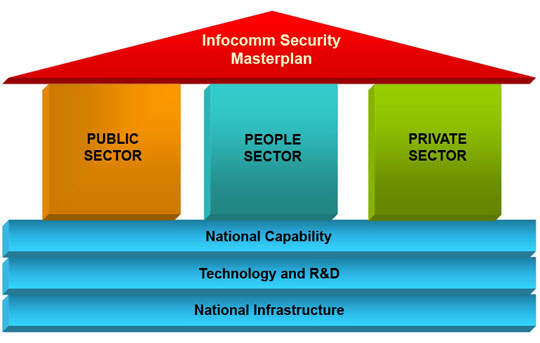
provides the overarching plan in Singapore's continued national efforts to enhance cyber security. Launched in February 2005, this three-year (FY2005 - FY2007) strategic roadmap is the result of extensive private and public sector feedback to increase the resilience of national critical infrastructure from cyber attacks and to maintain a secure infocomm environment for government, businesses and individuals. The Masterplan has identified six strategies to secure Singapore's infocomm environment:
-
Securing the People Sector
-
Securing the Private Sector
-
Securing the Public Sector
-
Developing National Capability
-
Cultivating Technology and R&D
-
Securing National Infrastructure
Pictorial Representation of the Masterplan Framework
Complementary to the ISMP is the
National Trust Framework (NTF)
, which was conceptualised in 2006 as part of IDA's iN2015 Masterplan. With the pervasive adoption of online services such as banking, healthcare and commerce, a trusted infocomm environment is essential to minimise security risks to valuable and sensitive data. Thus, the objective of the NTF is to develop a national framework that provides greater assurance and trust, so that Singapore can continue to leverage on its infocomm successes. To enhance Singapore's reputation as a trusted hub, the NTF has identified four key strategic thrusts:
-
Trusted infrastructure development
-
Manpower development
-
Education and adoption
-
Regulation
To achieve the objectives of the ISMP and the NTF, some of the key initiatives that Singapore has undertaken include:
The
National Cyberthreat Monitoring Centre (NCMC)
provides the Singapore Government with the capability for early detection of potentially devastating cyber attacks and the ability to respond to cyber security incidents in real time. The NCMC consists of the Cyber Watch Centre (CWC) that provides round-the-clock monitoring of cyber-threats to critical installations in the public sector and the Threat Analysis Centre (TAC) that focuses on the analysis of cyber threats.
The
National Authentication Framework (NAF)
aims to catalyse e-business through the pervasive deployment of strong authentication infrastructures across key sectors. The objective of the NAF is to enable a consistent second-factor authentication experience for end-users accessing key electronic services, such as banking, telecommunications and government services.
The
Critical Infocomm Infrastructure Surety Assessment (CII-SA)
was set up to assess the infocomm security readiness of Singapore's critical infocomm infrastructure (CII), and to ascertain the adequacy of the infocomm protection measures implemented by infrastructure owners and operators.
The
Business Continuity Readiness Assessment Framework
and the
Infocomm Security Health Scorecard
were put in place to measure the level of security readiness and preparedness of the public sector. The
Business Continuity Readiness Assessment Framework
established a common framework to measure the level of readiness of agencies in resuming business operations in the event of service and operation disruptions due to infocomm security incidents. The
Infocomm Security Health Scorecard
established a scorecard to assess the level of infocomm security preparedness of public sector agencies.