

Talent
Sharing IT career insights
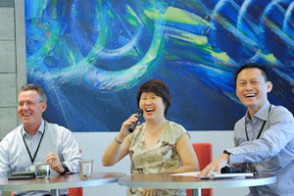
Mr Steve Leonard and his wife moved 17 times across multiple continents “chasing opportunities”. In 1996, they came to Asia. “When we got off the plane at Kuala Lumpur, we found ourselves standing on the tarmac in 34-degree heat,” he recalled. “My wife was horrified. She asked me, ‘Why did we leave London to do this?’ I don’t know. It seemed like a good idea at the time.”
“That is the whole idea of trying,” he said. “You don’t know how things are going to turn out? Try. Take a risk.”
Mr Leonard (left, in the picture above) was speaking at a Singapore Computer Society’s Youth Engagement Series (YES!) event on 15 February, where more than 100 ICT students and young ICT professionals filled The Coffee Connoisseur at Samsung Hub to listen to three industry veterans share about their experiences in the industry and their insights into the future of ICT jobs in Singapore and the region.
Mr Leonard’s own career trajectory eventually landed him in Singapore, where he ran tech companies across Asia for 13 years before taking on the role of Executive Deputy Chairman of the Infocomm Development Authority of Singapore (IDA) in 2013.
Succeeding in the IT industry is about seizing opportunities, taking risks, and working very hard, he said. “There is no short cut to the large corner office with a high salary.”
Ms Janet Ang (centre, in picture above), Managing Director, IBM Singapore, agreed. To those aspiring to become MDs, she said, “Start by managing yourself – your own priorities and your own skills. Don’t try to fly when you don’t know how to run. You have to build your skills to be future-ready, and then you have to prioritise in terms of what you have to do in a day, and go execute it and make it happen.”
“We all have to be able to create value. If we can create value and the value is recognised, there will always be opportunities for us to progress.”
She cited a study by the IBM Institute of Business Value, which interviewed C-level executives for their views on the key drivers of change and growth in their industries. Just four or five years ago, technology ranked number six on the priority list for Chief Executive Officers (CEOs), she noted. For the past two years, tech has been number one. “It is the key driver that CEOs have identified across all industries across the globe. What this means is that this is a sector that presents tremendous opportunities and will have a high impact on all businesses.”
Singapore is well positioned to capitalise on these opportunities because it has one important factor in its favour, and that is talent. “Talent is one of our key strengths,” said Mr Koh Kong Meng (right, in picture above), Vice President and General Manager, Lenovo East Asia. “As I work with colleagues and business partners across Asia, one thing that stands out is the quality of talent that we have in Singapore. There are people from Singapore who have made it in large MNCs and in entrepreneurial companies, and we do have young people coming up with innovative ideas.”
There is nothing to stop the next Flappy Bird from being developed in Singapore, he said. “It takes imagination and a lot of hard work.”
But, wearing his IDA hat, Mr Leonard has set his sights beyond the Flappy Birds. He is looking for the next big thing.
“We have so many entrepreneurs solving problems within a 2-km radius. Where is the next Facebook? The next Google? We need to think about big problems. We need to build something important that affects people around the world, because that is how big companies are made; that is how small companies become big companies; and that is how wealth creation occurs.”
He cited healthcare as one example of an area that affects people around the world. Technologies such as “in-you” sensors, for instance, can enable people to monitor their health and make a difference in the way care is delivered.
What Singapore needs is big ideas, said Mr Leonard. “Let’s think about big ideas that make a big difference to big markets, with Singapore as a hub for these developments.”
One member of the audience who expressed an interest in healthcare was Mr Andi Prayogi, who is pursuing an IT degree at the University of Newcastle. He hopes to work in the healthcare sector after graduation. “There are so many issues in hospitals that IT can help with. By working in the sector, I can have a better understanding what is needed, and I’ll also know what I need to develop in terms of competencies and skills.”
Eventually, he would like to be a tech entrepreneur developing solutions in healthcare, but working for a few years in the sector will provide him with a good foundation to start a business, he said.
Also amongst the audience was Mr Andi Suria, who is pursuing a Business and IT degree at UniSIM’s School of Science and Technology. For him, being a tech entrepreneur allows him to marry his twin interests of selling and building things with tech. “I like to sell. It’s rewarding when you can produce something that people find useful,” he said. “And I am also interested in technology. I like to see how it can be used to solve people’s problems.”