

Talent
Creating smart solutions for everyday living
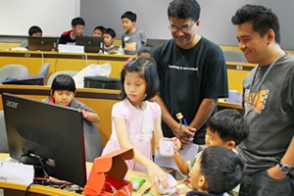
From Batman’s ultrasonic sensing capabilities to a sign that said “Don’t pee on the electric fence”, teams taking part in the code::XtremeApps::2013 programming competition drew inspiration from varied sources as they sought to develop innovations aimed at improving various aspects of everyday life.
Organised by the Information Technology Standards Committee (ITSC), code::XtremeApps::2013 aims to foster computer programming interest at a young age. The competition falls under the Infocomm Development Authority of Singapore’s (IDA) purview of nurturing infocomm talent and developing infocomm competencies across key economic sectors in Singapore.

The Superbot team in action in the foreground: Wang Heng Yue (in blue) and Ryan Ong.
“Innovation can happen anywhere and with anyone with an inventive mind. code::XtremeApps provides a platform to enable IT enthusiasts to harness the power of their imagination to enrich lives with the creative use of infocomm technologies,” said IDA’s Chief Technology Officer Mr Leong Mun Yuen, who was also one of the judges at the competition. “At IDA, we are committed to developing a vibrant and sustainable infocomm education landscape to raise infocomm sophistication levels and encourage innovation and entrepreneurship amongst the youths. Nurturing our local infocomm talent is key to growing Singapore’s pool of skilled professionals that is well-placed for a vibrant and globally competitive industry. This annual round-the-clock competition is certainly a step forward in the right direction.”
Besides IDA, code::XtremeApps::2013 was supported by the IT Management Association, National University of Singapore, Singapore Computer Society and Singapore Infocomm Technology Federation. This year’s winners were announced on 15 August at a prize presentation ceremony graced by Associate Professor Lim Tit Meng, Chief Executive of Science Centre Singapore.
The theme for this year’s competition was “Smart Living – Build. Code. Play.” For the first time since the competition was inaugurated in 2007, contestants not only had to program their applications using the stipulated operating systems and software platforms, they also had to work within the hardware confines of Raspberry Pi, a low-cost credit card sized single-board computer, or Arduino Uno, a microcontroller board. Contestants under the Junior Category had to make use of Makey Makey, a circuit board invention kit that converts everyday objects into computer input devices.
For the Junior Category, which caters to children aged 12 years and below, the teams were tasked to program a popular cartoon character (Minions in Despicable Me) to perform tasks such as cleaning the house or singing a song, using the Makey Makey invention kit.
The winning innovation came from the Superbot team of Ryan Ong and Wang Heng Yue, both Primary 3 pupils at Temasek Primary School. They wrote a program which made use of cups to trigger musical notes and control the movements of the cartoon character. The idea came up when they spotted a sign that said “Don’t pee on the electric fence” and realised that water was an excellent conductor of electricity. They then programmed the Makey Makey so that it could be activated by pouring water into the cups.
In the Open Category, this year’s Grand Prize went to the team Sons of Pitches for its Batman-inspired indoor localisation solution. The team, comprising Nanyang Technological University graduates Mr Chen Chiu Hao, Mr Phyo Ko Ko and Mr Shen Shuo, created an indoor positioning application using the Raspberry Pi and high-frequency sound waves that were inaudible to the human ear.

A winning pitch: (From left) Mr Phyo Ko Ko, Mr Chen Chiu Hao and Mr Shen Shuo.
Instead of locating objects wirelessly through Wi-Fi or Global Positioning System, sound waves were used to detect and analyse human traffic and behavioural patterns, allowing retail organisations to personalise marketing messages and offers according to the shopper’s location.
“Prior to the competition, we got the sound localisation to work with a lower frequency which was audible to humans as an annoying beeping sound,” said Mr Chen. “Shifting it to higher frequency during the competition was defiantly a challenge.”
BluBerry Souffle, a team formed by three working professionals, bagged the second prize and a special prize sponsored by the Velocity@Novena Square mall. The team created a real-time system that incorporates sensors, geo-location heat map, augmented reality and social media applications to monitor shopper traffic and allows retailers to deliver targeted marketing campaigns for an enhanced shopping experience.
Swordfish, which also comprised NTU graduates, took home the third prize. They created a voice-controlled portable device for the visually handicapped that reports on time and weather, and allows them to send text messages and control lighting through voice commands.
“Contestants had a tougher time this year as they had to work within the boundaries of stipulated hardware and software platforms to create innovations that enhance smart living in Singapore. Yet, the entries we received this year were of exceptional standard, and our judges had to make difficult decisions to determine the final winners,” said Associate Professor Benjamin Gan Kok Siew, Chairman of the code::XtremeApps::2013 Organising Committee. “We were extremely impressed with the level of sophistication seen across this year’s entries which many will have a real commercial or practical value.”