

Special Reports
2012 in Review: Infocomm Landscape
In line with the iN2015 masterplan, IDA has been monitoring the technology landscape to chart Singapore’s infocomm development to ensure that the key enablers for the Intelligent Nation are in place.
Infrastructure
A key infrastructure piece for iN2015 is the Next Generation National Infocomm Infrastructure (Next Gen NII) which will support bandwidth-intensive activities as Singapore becomes more sophisticated in its use of infocomm. In mid-2012, a major milestone was reached in the rollout of the wired component of the Next Gen NII – the Next Generation Nationwide Broadband Network (Next Gen NBN) – when OpenNet fulfilled its obligations to deploy the fibre network to 95 per cent of homes and businesses in Singapore.
IDA also continued work with the industry and end-user organisations to explore innovative ways of harnessing the Next Gen NBN. An example was the launch of a Call-for-Collaboration (CFC) for pilot projects that make use of the Next Gen NBN for home-based work and the setting up of Smart Work Centres. This was aimed at encouraging employers to adopt flexible working arrangements through the use of infocomm technology. ( Read )

|
“Working at home used to mean bringing work back in a hard disk and working in a silo. With the Next Gen NBN and a virtual private network, we can now access huge amounts of data in the office server from home and collaborate with our colleagues. Having an option to work from home is mainly about the people – being able for Spinn to cast a wide net for talents, better balance of work-life, and the reduction of burn-outs.”
- Mr Foh Chit Yee, Founder, President and Executive Producer of Spinn Pte Ltd
On the wireless front, IDA has also announced a CFC for the next phase of the Wireless@SG programme, which is expected to run from 2013 to 2017. Interested operators and service providers are invited to collaborate with IDA to provide and operate public Wi-Fi deployment that meets the key requirement and scope of the CFC such as the implementation of authentication mechanisms that will provide users with seamless access to the wireless network. ( Read )
Meanwhile, high-speed connectivity enabled by the Next Gen NII has paved the way for the adoption of services such as cloud computing, which gives businesses and end users access to applications such as word processing, storage and even compute power through the Internet. Accompanied by a subscription-based business model, cloud computing has the potential to catalyse infocomm adoption amongst businesses, especially small and medium enterprises.
To make further progress in the adoption, the Cloud Computing Standards Coordinating Task Force established by IDA and the Singapore’s Information Technology Standards Committee published two Technical References in March on guidelines, best practices for virtualisation and cloud security. IDA has also launched its fifth and sixth Call for Cloud Computing Proposals, inviting interested parties to submit proposals for innovative and cloud-based projects. ( Read )
Technology
IDA continued to monitor the technology landscape to identify strategic infocomm developments and work with relevant public and private sector players in areas such as policy, regulation, manpower development, technology pilots and trend mapping. Some of the technology areas that came under the spotlight in 2012 included IPv6, geospatial technologies and green ICT.
To address issues surrounding the depletion of 32-bit IPv4 Internet addresses and drive transition to the next-generation Internet addressing protocol IPv6, IDA organised the IPv6 Conference and Workshops in July/August. Topics such as Security as well as Business Opportunities Innovation were also discussed at the event. ( Read )
In the area of geospatial technologies, development grants were awarded to five companies – StreetSine, V3 TeleTech, Maek Consulting, Mevo and ShowNearby – under IDA’s i-Singapore@Work CFC to promote the integrated use of Government's geospatial data with the private sector's data to derive benefits for citizens and businesses. Under the CFC, applications are being developed in areas such as real estate, construction, building management and workforce management. ( Read )
Issues surrounding Green ICT also gained further traction in 2012. A new tax incentive, the Investment Allowance Scheme for Energy Efficiency Projects (Data Centres), was introduced to encourage data centre operators to be more energy efficient. Under the scheme, an Investment Allowance is granted to eligible companies to offset the fixed capital expenditure incurred in implementing energy efficiency retrofits for their data centres. ( Read )
A dedicated green building rating system, the Green Mark for Data Centres, was also launched by the Building and Construction Authority and IDA to encourage the adoption of energy-efficient design, technologies and systems among local data centre operators. ( Read )
IDA also selected four consortia – led by Equinix Singapore, Toshiba Asia Pacific, ClearManage and 1-Net Singapore – for its Green Data Centre Innovation Challenge CFC, which was aimed at uncovering innovative green ICT solutions that can help improve energy efficiency in the data centre sector. ( Read )

|
“Data centres are traditionally known for being energy-intensive facilities, with energy consumption contributing to half of their overall operating costs. In light of the various environmental implications, data centre providers have also increasingly been taking the necessary steps to ensure that eco-friendly and intelligent approaches are being adopted. Green design, energy efficiency and sustainability approaches should not only be viewed as checklist features, but rather a holistic methodology to create the optimum facility that is great for both a business’ IT needs as well as the surrounding environment and society.”
- Mr Clement Goh, Managing Director, Equinix South Asia
Looking ahead, IDA has been engaging the public on the Infocomm Technology Roadmap (ITR) 2012 which seeks to chart the vision, trends and future developments of the technology landscape in Singapore and align Singapore’s technological direction with global infocomm developments.
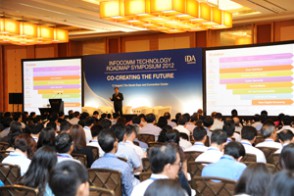
The roadmap clusters technologies around nine themes: Big Data, Cloud Computing, Cyber Security, ICT and Sustainability, Communications of the Future, Social Media, New Digital Economy, User Interface and the Internet of Things. These themes were discussed at the ITR Symposium 2012 in August, which served as a platform for discussing the technologies and innovation opportunities by tapping on industry insights, experiences and feedback from the community to improve the roadmap and develop a shared technology vision. ( Read )