

SMEs
Empowering SMEs through technology
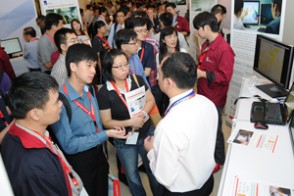
A*STAR’s Institute of Infocomm Research (I 2 R) is adopting a two-step approach to help small and medium enterprises (SMEs) adopt cutting-edge technology to boost productivity. Speaking at ICM Horizons 2013, Dr Tan Geok Leng, Executive Director of I 2 R, said technology plays a key role in empowering SMEs by automating their processes and improving workflow.
“In response to the need to improve the productivity of enterprises in Singapore, we want to make our technologies ‘ready to go’, so that it will be easier for local enterprises to adopt these technologies to improve their productivity and grow their business,” he said.
The I 2 R flagship event, which was held on 9-10 October, showcased Intelligence, Communications and Media (ICM) innovations which have been translated from the institute’s research into readily-deployable solutions for businesses looking for more efficient ways to meet their customers’ needs.
The first stage in empowering local enterprises through technology involves working with SMEs and systems integrators to develop reference solutions or proof-of-concepts to demonstrate how the ICM solutions can help them in their business, said Dr Tan Guan Hong, Productivity Programme Director, I 2 R. “The proof-of-concept is important for end users who do not understand technology. It makes it cost-effective for SMEs to see how the technology can be deployed, so that they can decide if it is what they want, or do not want.”
This will help break the chicken-and-egg cycle, where SMEs hesitate to deploy a technology because they are unsure of its benefits, and the potential of the technology to help them in their business remains untapped because of this reluctance. For systems integrators, the process of working with SMEs on the proof-of-concept enables them to get clearer picture of the SMEs’ requirements for a particular solution, and opens up the opportunity for them to further develop the solution and build a bigger business around it.
The second stage of I 2 R’s efforts is to help SMEs lower the cost of technology adoption by leveraging Singapore’s strengths in 3G, wireless infrastructure and the cloud. “If adoption costs remain high, the technology will always remain in a niche market,” said Dr Tan Guan Hong. I 2 R is addressing this by pooling ICM resources through platform technologies – a common set of tools and services made available via the cloud. Businesses can then build on these technologies and tools to create value for themselves and their customers. This will help aggregate demand and enable SMEs to enjoy economies of scale, bringing down the cost of technology adoption.
Two sets of technologies that I 2 R will be making available via the cloud by end October are the image recognition platform Snap2Tell, and sensor networks.
Snap2Tell is an intelligent platform for rapid and easy creation of mobile apps for multimedia information access via mobile devices. A web-based portal is provided for users to create their own mobile apps in a few minutes, without the need for any programming or knowledge in image recognition.
I 2 R’s sensor networks provide connectivity as well as monitoring and alert tools for a wide range of applications such as pest control, water level management, equipment monitoring, healthcare monitoring and many more.
Some of I 2 R’s sensor-based solutions that were showcased at ICM Horizons included:
- An innovative sensor mat embedded with multimode optical fibre that enables continuous monitoring of breath rate, heart rate and body movement without the need for wearable straps or sensors on the body.
- A revolutionary emergency monitoring system called Sound-Eye that detects abnormal sound events. For example, during an emergency, the system will detect and recognise a person’s shout or scream for help and send alerts to the care-giver.
- A Perimeter Intrusion Detection System that makes use of Fibre Bragg Grating Sensors to accurately pin-point the location of an intrusion.
- A cost-effective and scalable sensor network solution with data analytics capabilities to monitor machine health in a highly-automated business environment.
- A vision-based sensing platform that detects the availability of car park lots indoors or in open areas and can help drivers monitor their vehicles remotely.
- An Attentive Teleconferencing Solution that uses speech-source technology and a microphone array to detect the source of a human voice and detects the speech source for various purposes such as surveillance and video-conferencing.
- A telepresence robot that directs its attention to a speech source and “listens” to the person who is speaking. The Attentive Teleconferencing Solution uses speech source technology and a microphone array to detect human voice and has applications in surveillance and video-conferencing.