

In the News
The Big Debate
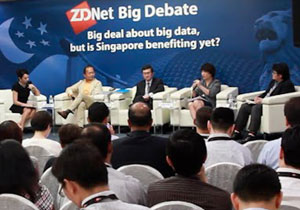
Significant value is derived only when data is analysed and made available for sharing where possible, say panellists at the Big Debate. (Photo: ZDNet Asia) |
Data has been described as a new natural resource and presents a competitive advantage and growth opportunity for companies in Singapore. However, value is derived from the data only when it is analysed and made available for sharing where possible. These were some of the views put forward by panelists during ZDNet Asia’s Big Debate on the topic “Big deal about big data”, which was held on 28 November.
“Big data is about outcomes,” said Ms Janet Ang, Managing Director of IBM Singapore. “If we have tons of data but cannot make sense of it, it is of no use.”
In the healthcare sector, for example, large volumes of data are being analysed to discover ways to improve the level and quality of care. This goes beyond normal transactional information to encompass data from patient monitoring systems, building management systems, videos, images, and even web clicks that indicate interest from potential patients and visitors, said Mr James Woo, Chief Information Officer of medical and hospitality specialist The Farrer Park Company.
Also taking part in the discussion was Mr Jude Yew, Assistant Professor, Department of Communications and New Media, National University of Singapore, who pointed out that the promise of big data and analytics lay not just within the data itself, but also in uncovering previously unnoticed connections between different and unrelated data sets. Ultimately, these new connections and insights could be combined to deliver greater value to end users, he said.
What this also means is that the “consumerability” of big data is right in front of us. Ms Ang cited the example of maps and related data which have been made available by the Singapore Land Authority, paving the way for the creation of a whole myriad of applications. “This is a positive proof point,” she said. “The door must be open. The sharing of data must happen, after taking into consideration privacy and governance issues.”
This vision is shared by the Singapore Government, which has made available about 7,000 government-related data sets on the portal data.gov.sg for the development of innovative applications and services. “It is a journey that all government agencies are taking,” said Mr Tan Eng Pheng, Senior Director, Industry Cluster Group, at the Infocomm Development Authority of Singapore (IDA). “Where the agencies have data that they think is relevant and does not violate any regulation that prohibits sharing with the public, every effort will be made to share the data in a machine readable format, where possible, so that businesses can make use of it.”
Recognising the tremendous opportunities in this area, IDA is working with various industries to make use of data analytics to boost their competitiveness. Mr Tan noted that while certain sectors such as financial services and telecommunications are generally more advanced in the use of analytics, other sectors face challenges in terms of the cost of adoption, as well as resistance from business leaders who question the value of implementing analytics tools.
One of the issues highlighted during the discussion was the difficulty in measuring the return on investment (ROI) of big data. ROI is used to justify investments in analytics tools to business leaders. Mr Woo suggested that one way of obtaining buy in for analytics projects was to study other successful analytics projects, and use this as an input to project potential returns. “Start small and if it’s successful, then scale it up,” he said.
From the government’s perspective, aggregating demand for analytics solutions where it makes sense can help companies to adopt analytics solutions more easily. IDA is working with industry partners to introduce shared services to lower the cost of adoption of analytics tools. In May 2012, IDA and its industry partners introduced business analytics shared services for the retail and wholesale sectors. Three business analytics shared services are under development and will provide analytics applications as a service to support retailer front-end customer analytics, back-end inventory optimisation and wholesaler operations analytics.
IDA is also looking to enable the data and analytics ecosystem from the supply side. It is working with other government agencies to help lead multinational corporations set up business analytics competency centres in Singapore. The aim is for these players to serve as a magnet to attract and develop local talent in the business analytics space.
A third area that IDA continues to focus on is the development of infrastructure to support public cloud service providers in the delivery of business analytics shared services. This includes hard infrastructure such as the Next Generation Nationwide Broadband Network, as well as soft infrastructure in the form of standards and legislation.
An example was the recent introduction of the Personal Data Protection Act, which ensures that there are adequate safeguards to protect personal data. What this means is that when data is collected by a business, the business must obtain consent from the customer with regard to the intended use of the data. The Act will not supercede sector level requirements for data privacy, but is a baseline law that brings consistent personal data protection practices across all businesses, said Mr Tan. “It sends the signal that we are serious about making Singapore a data hub.”