

In the News
Licensing innovations to create competitive advantage
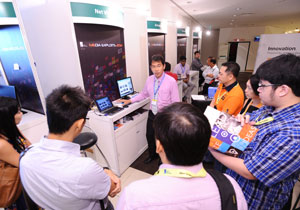
Mr Winson Wee of Reachfield IT Solutions presenting Net Video Cloud to visitors at Media Exploits 2012. |
Small and medium enterprises are discovering that they do not necessarily have to put in a huge R&D investment to come up with technology innovations. Instead, they can take the alternative route of licensing technologies from local research institutes to differentiate themselves from their competitors.
Some of these licensing stories were shared at Media Exploits 2012, an annual exhibition cum forum organised by Exploit Technologies Pte Ltd (ETPL), the technology transfer arm of the Agency for Science and Technology Research (A*STAR).
ETPL is focused on taking technologies from the research lab and transferring them out to the industry, said its Senior Vice President Mr Lee Han Boon. This involves bringing together technology suppliers such as the research institutes, technology translation centres to package the technologies into forms that businesses can use, grants and incubators, institutes of higher learning to help with the ideation process, and ETPL itself as an adopter of some of these technologies. “Technology commercialisation is a lot about building ecosystems and getting the adoption,” he said.
Media Exploits, which took place on 1 November, provided a showcase of technologies from A*STAR’s Institute of Infocomm Research ( I 2 R), the Advanced Digital Sciences Centre, Data Storage Institute and the Singapore Bioimaging Consortium, as well as partner solutions in areas such as mobile applications, analytics, media processing, 3D graphics, and augmented reality.
Speaking at the forum, Mr Winson Wee of Reachfield IT Solutions spoke about how his company created a competitive differentiator by licensing the Scalable Multimedia Platform (SMP) from ETPL and incorporating the technology, which originated from I 2 R, into its solutions and product offerings.
With its focus on digital assets management, Reachfield was looking to broaden its portfolio by helping businesses deliver digital video online to meet their corporate needs. It incorporated SMP to deliver Net Video Cloud services powered by StarHub’s Cloud – Argonar, which reduces the complexity involved in delivering effective video-on-demand as a turnkey subscription service.
Net Video Cloud ingests the video source, for example AVI, FLV, WMV, MP4 or MOV files, and automatically transcodes it into a highly compressed format that is optimised for different screen resolutions and networks ranging from 256 kbps for mobile devices to 10 Mbps for high definition video clients. This allows the video to be streamed seamlessly and transparently to different devices. All the user needs to do is to upload the video source and share the link.
Previously, users would have had to pre-process the input video by encoding them multiple times into several files of different video resolutions and bit rates, applying digital rights management software if required, and disseminating them using different players. By using SMP, the ingested video source is transcoded only once into a single scalable compressed file. With true video scalability, the SMP server provides on-the-fly adaptation to deliver the best possible multi-screen video experience to heterogeneous clients over fluctuating network conditions. To the content owners, there is only one file, one server, for all user devices; while the end-users enjoy uninterrupted videos without the annoying “stop-rebuffer-resume” experience.
Reachfield’s first customer for SMP technology was NUS High School of Mathematics and Science, which uses it to disseminate online lectures that students can access for revision or self-study. “In the past, students used to be deskbound but with this platform, they are able to access content from their tablet, smart phone or on the PC. They are no longer tied down to a particular platform,” said Mr Wee.
Another company which took the licensing route to create a competitive advantage was Knorex, which was formed in 2010 as a data mining spin-off from I 2 R.
Knorex’s focus is in the areas of text mining, analytics, semantic technologies and text processing, said its Chief Executive Officer Mr Justin Choo. Its first licence was for Knowlesuite, a suite of automated knowledge acquisition applications and services, from I 2 R. This was followed by the licensing of Snap2Tell, an advanced image recognition technology.
Knorex went on to marry the two technologies and create a cloud-based recognition server Knorex ARise, which won a merit award at the recent National Infocomm Awards presented by the Infocomm Development Authority of Singapore. Knorex ARise provides an end-to-end augmented reality platform for transforming print advertisements and editorial contents into interactive experiences. Besides providing contextually relevant contents to readers, these engagements also translate into measurable outcomes and leads for the publishers and advertisers.
Knorex’s first partner to use Knorex ARise was Star Publications, which produces Malaysia’s leading English language daily. Delivering the keynote at Media Exploits, Ms Wong Siah Ping, Chief Operating Officer for Digital Business at Star Publications, spoke about how The Star integrated a new feature called iSnap into its mobile app, The Star Mobile, to “turn the newspaper into TV”. By hovering their mobile devices over the advertisements or news with an iSnap logo on the page, readers are able to watch related videos or articles, listen to songs that are being reviewed, locate the nearest outlets related to an advertisement, view picture galleries, leave a comment, tweet or share the article.
The number of downloads and updates of The Star Mobile increased by 93 per cent within a month of the launch of iSnap. By capturing data on how iSnap is used, the application also provides The Star with statistics on readership and new insights into its print business, paving the way for The Star to explore new types of advertising revenue and ideas.
Snap2Tell, Knowlesuite and SMP are just three of the many technologies that are available for licensing. ETPL currently manages some 3,500 patents and applications and has issued more than 450 commercial licences since 2002.