

ICT Enterprises
Through the looking glass
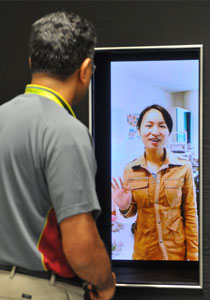
With i2i, users feel that they are standing opposite the person they are talking to, even though the other party may be kilometers away. |
Imagine talking to someone through a glass window – except that the person is not at the other side but could be up to 30 km away. This is the futuristic scenario made real with i2i, the world’s first personal telepresence system based on a talking picture frame concept.
The i2i system was one of the many innovative technologies that were showcased at the recent TechFest 2009 exhibition organised by the Institute for Infocomm Research (I2R) on 7-8 October 2009 in conjunction with its annual seminar Infocomm and Media Horizons.
The idea for i2i came about when an I2R research team was looking for a way to demonstrate the capabilities of optical fibre networks. “We decided to build something like this to interact with visitors and to allow us to demonstrate our technologies,” said I2R’s Principal Investigator Dr Yeo Yong Kee.
To develop something unique, the team eschewed the idea of a normal video web-cam set-up. Neither did it want to replicate commercial video conferencing systems. Instead, it decided to build an individual telepresence system with a different form factor – something that will enable users to walk up to a frame on the wall and “talk” to the person on “the other side”. The effect is to let the users feel that they are standing opposite each other. To make the experience even more realistic, all images are transmitted in full High Definition 1080p format using an ultra-high-speed video codec to minimise lag.
The system also comes with an integrated data-transmission unit which allows users to send and receive large documents while they are engaged in a conversation. DVDs, games and other large files can be transmitted in a flash using the 1Gbps Ethernet interface. The technology for connecting the two end points is based on the Ethernet Passive Optical Network/Gigabit Passive Optical Network (EPON/GPON) standard or on I2R’s proprietary Wavelength Division Multiplexed Passive Optical Network (WDM-PON) technology.
According to Dr Yeo, one of the challenges the team faced in developing the system was to position the camera such that it was hidden from view, but could capture the users’ image as if they were looking straight at it. This meant that the projector and the camera needed to be in the same position – something that required “some engineering effort”.
To make the leap from the research lab into the commercial world, the i2i system will also have to address some other issues such as shrinking the size of components in order to minimise the depth of the picture frame. Costs will also have to be reduced before the system can be ready for the mass market. Some of the existing technologies, such as state-of-the-art video compression technology needed to ensure minimal lag, is still very expensive, said Dr Yeo.
He estimated that such a system would currently cost between S$10,000 and S$20,000. The target is to bring this down to a few thousand dollars or even lower, so that its use can take off in areas such as telemedicine, tele-meetings, e-learning, job interviews, dating services and in military or security applications.
The i2i system is part of a larger project to build an optical test bed in Fusionopolis. This, in turn, can be used to pilot applications for Singapore’s Next Generation National Broadband Network (Next Gen NBN). When rolled out nationwide by 2012, the Next Gen NBN will deliver speeds of up to 1Gbps to every postal address in Singapore.
The Fusionopolis project, Fusion Light, will create an optical network ecosystem with thousands of fibre-end points going to the desk, which simulates a Next Gen NBN access point. Through this network, users will be able to access i2i, transfer files, watch videos, trial next generation IPTV systems or test out other potential Next Gen NBN services.
The WDM-PON advantage
Using Ethernet Passive Optical Network (EPON) or the Gigabit Passive Optical Network (GPON), multiple users share a single wavelength of light to transmit their data, just like multiple cars on the road making use of just one lane. With Wavelength Division Multiplexed Passive Optical Network (WDM-PON), however, multiple lanes can be opened up. This increases capacity, allowing more users to go onto the same network. Dedicated highway links can also be set up for “super users”.
According to Dr Yeo Yong Kee of the Institute of Infocomm Research, WDM-PON technology can help increase the capacity of an optical network by four to five times, compared with the use of a single EPON. There is also a non-disruptive upgrade path for existing GPON/EPON networks to WDM-PON.