

ICT Enterprises
Supporting Singapore infocomm
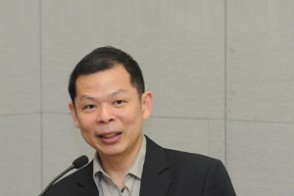
IDA Accelerator, IDA Accreditation and IDA Labs – these are some of the initiatives the Infocomm Development Authority of Singapore (IDA) will be focusing on to ensure that local companies retain their competitive edge in a dynamic global ecosystem.
Mr Andrew Khaw (pictured above), Senior Director of IDA’s Industry Development Group said this at its Global Industry Forum for local business leaders held on 15 January.
Under accreditation efforts, IDA will “test drive” local innovations and provide a form of quality assurance. This will give government agencies greater confidence to adopt these solutions, he said.
As part of the accelerator programme managed by IDA’s investment subsidiary Infocomm Investments Pte Ltd, start-ups will be put through an “internship” where they will be challenged as to the kind of “go-to-market” strategies that they have, whether their business are scalable and whether they have the right people. This will help raise the quality of start-ups in Singapore.
As for IDA Labs, the aim is to build technical capabilities through “tinkering with tech” and attract more young people into the industry, sustaining the country’s standing as a leading infocomm hub, said Mr Khaw.
During the forum, several of IDA’s centre directors from around the world also shared their unique insights on the current trends and opportunities in their respective regions. Contrary to some predictions, the American market remains robust, said United States’ Centre Director Mr Victor Tan. Home automation is expected to grow strongly, along with the demand for wearable devices which are gaining popularity as a fashion statement. Big data is only going to get bigger. “Companies are now looking into ways to extract value from currently ignored data,” he said. Other potential areas of high growth include 3D printing for the masses and the development of robots and drones.
India is forging ahead with its plan to have two smart cities in each of its 28 states said the IDA Centre Director for the country Mr Sanjay RM. “India plans to develop a number of industrial corridors. The Delhi-Mumbai Industrial Corridor will offer 100 million manufacturing jobs,” he said. For technology companies, there will be opportunities in developing traffic management and water distribution solutions unique to the Indian marketplace, just to name two.
Turning to developing smart cities in Southeast Asia, Centre Director Ms Jacqueline Chan envisions that there will be greater use of ICT by governments, businesses and citizens of the region. Given Singapore’s expertise in this area, there is significant growth potential for local businesses to venture into regional markets. “Countries see Singapore as a good reference market where ICT solutions are implemented,” said Ms Chan. She identified healthcare (including telehealth and telemedicine), building and environment solutions (such as building automation), education, transport and government services (such as e-government solutions) as some of the key areas for possible collaborative ventures involving Singapore infocomm companies.
As for the Middle East, Mr Adrian Tan, Centre Director for the region, said that the governments there are increasingly looking eastwards for business opportunities. “Countries there want to move away from a hydrocarbon-based economy to a knowledge-based one,” he said. To tap on the opportunities, Singapore businesses will need to partner with local enterprises and adapt to the cultural differences and business practices in the Middle East. There is tremendous growth potential particularly in infrastructure development, with many mega events on the horizon such as the Expo 2020 in Dubai and the 2022 FIFA World Cup in Qatar.
China too is poised to see explosive growth in the development of smart cities said Centre Director (North China) Mr Joshua Lau. Its Ministry of Housing and Urban-Rural Development which launched the China Smart City Guidelines, announced that it now has almost 200 smart city test sites across the country and these projects can tap on a credit line of some 440 billion RMB (S$90 billion) provided by three major banks and institutional investors. With the growth of Chinese smart cities reaching a fever pitch, Mr Lau urged local companies to work closely with the IDA in exporting their smart city solutions to China.
In a more sobering vein, Mr Adrian Long, General Manager of V3 Teletech, presented on the challenges and hurdles that the company faced in its earlier attempts to go global. “Perhaps we were a little naïve when we first started. We did not do much research or align our employees for the challenges faced,” he said. “We had a weak network with our partners and there were many cultural differences and business engagement practices that we needed to adapt to.”
Still he said his company, a leading telematics service provider, was able to overcome these obstacles and eventually prosper. “We were able to leverage on IDA’s overseas offices, tap their assistance, schemes and contacts.”