

ICT Enterprises
Examining the transformative potential of IoT
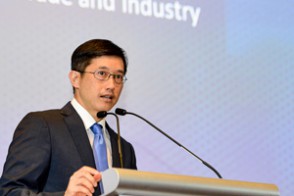
The Internet of Things (IoT) offers many opportunities for business transformation, said Mr Teo Ser Luck (pictured above), Minister of State, Ministry of Trade and Industry, Singapore. Firstly it can create a new market for products and services that previously did not exist. Secondly, it is an enabler for productivity, allowing processes to be improved through real-time monitoring. This paves the way for more efficient deployment of scarce resources and better service delivery.
Mr Teo was delivering the opening address as Guest of Honour at the IoT Asia 2014 Conference and Exhibition, which was held at the Singapore Expo on 21-22 April.
He noted that IoT is not something that is new, but there is a need to repackage it and extend its applications so that it becomes more accessible and affordable to businesses and organisations.
And while it has got off to a good start, its full value can only be unlocked by taking one step further and integrating multiple sensors for a more systematic response. Giving an example from the public sector, Mr Teo cited how water level sensors and CCTVs have been deployed to monitor drainage systems and work in concert to provide real time alerts when water levels rise.
With IoT, the potential for new applications and new business models is immense, he said. It will benefit businesses, households and individuals in many different ways.
This potential is exactly what the Infocomm Development Authority of Singapore (IDA) is focusing on. In his keynote address at the conference, Mr Steve Leonard, its Executive Deputy Chairman, said one of the questions to think about is how IoT can have a positive impact and improve the lives of people around the world.
He gave the example of how sensors in contact lenses can help monitor blood sugar levels of diabetic patients through their tears, and how sensors on epilepsy sufferers can help detect seizures and send alerts to caregivers, and at the same time capture data that will allow researchers to find out more about the condition.
Before IoT can realise its full potential, however, there are several issues that have to be addressed. From the technological perspective, there is a need to think about data layers, security and communications. “These are practical issues. Without these working, IoT is not achievable,” said Mr Leonard.
There is also a need for the harmonisation of standards in this space. In line with this, IDA is setting up an IoT standards committee to make sure that Singapore has a voice in this area, and is brought into any dialogue on standards in IoT.
Another issue relating to IoT is that of anonymity – how far information can be made available without it being traced to specific individuals, how much society in general cares about their privacy, and how much people are willing to give up in order to improve their lives significantly through the use of IoT and other such technologies. “This is one of the questions that we have to think about,” said Mr Leonard.
He believes that Singapore is a “perfect microcosm” for the deployment of IoT and for examining some of these issues. It presents the same scenarios and challenges that every country has, but at a more manageable scale. “We are big enough to be a relevant test bed for use cases,” he said, citing examples such as an aging population, energy efficiency, public safety and logistics. “It is also small enough so when we need to make adjustments, we can do so fairly easily. Being big enough and small enough is a great strength for Singapore.”