

ICT Enterprises
Big data analytics gets in-memory boost
Big data analytics is about to get a speed boost with the launch of a made-in-Singapore supercomputer that allows up to 32TB of data to be loaded and analysed in-memory, removing a major bottleneck in analytics performance. And it does this at a fraction of the cost of traditional high-performance computing systems.
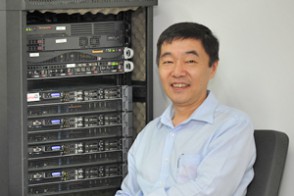
The NumaQ in-memory analytics appliance, developed by Singapore start-up 1degreenorth, makes use of commodity servers but introduces an architecture that overcomes the memory limitations inherent in cluster computing, explained Dr Zhao Pei (pictured above), Vice President of Business Development, 1degreenorth.
“With the normal architecture of a computing cluster, the memory available is limited by the memory of individual servers. No matter how many servers you combine in a cluster, the largest chunk of memory you can access is local memory.”
NumaQ overcomes this barrier by combining local memory to build a large pool of global memory that is optimised for in-memory computing. This creates a real (as opposed to virtual) symmetric multiprocessing (SMP) server whereby two or more identical processors are connected to a single, shared main memory, have full access to all input/output (I/O) devices, and are controlled by a single operating system (OS).
The architecture allows huge volumes of data to be loaded into memory for applications such as real-time analytics, data modelling or high-performance computing, resulting in performance that is up to 100 times faster compared with having to access the data on hard disks across various nodes in the cluster.
For 1degreenorth, this opens up opportunities in sectors such as telecommunications, finance, life sciences and government which want to do real-time analytics involving terabytes of data, but are currently being held back by the limitations of a distributed architecture, said Dr Zhao.
Take a telco, for example. If it has 100 million users and wants to do behaviour analysis in order to understand and respond to subscribers’ service usage patterns and preferences, it could sometimes take up to a week to generate a report. With in-memory analytics, the turnaround time could be as little as one day.
In the life sciences, research that involves the sequencing and mapping of the human genome requires analysis of huge volumes of data that could take weeks or even months. The adoption of in-memory analytics can significantly reduce this and shorten the overall research cycle, lowering research costs and leading to faster time-to-market for new products.
Conceptually, the SMP architecture is not new, said Dr Zhao. SMP technologies are currently available from supercomputer manufacturers but on a proprietary basis, making it expensive and leading to issues such as vendor lock-in.
By adopting an open approach using x86 servers, 1degreenorth is able to deliver the same capabilities at one-tenth of the cost. “You get SMP performance at the price of a cluster,” said Dr Zhao.
The NumaQ solution also provides scalability to a degree that is not possible with a software-based solution. In a normal cluster, jobs are distributed across various nodes which have to “talk” to each other in order to complete a task, explained software development manager Mr Tsai Liming. This can lead to very high communication overheads as the workload increases, undermining the efficiency of the system and slowing response times. Furthermore, there are certain jobs that cannot be divided up for distributed processing. “Mathematically you cannot break it down, or sometimes the nature of the job is serial,” he said.
NumaQ is the second major product milestone for 1degreenorth after the launch of NumaManager, a set of advanced share memory system tools which it introduced in 2011. These development efforts were supported by SPRING Singapore under its Technology Enterprise Commercialisation Scheme (Proof of Value) and also by the Infocomm Development Authority of Singapore.
Today, after two years of building, refining and optimising NumaQ in collaboration with test users in various organisations, 1degreenorth is now ready to take another big step forward in its plans to grow beyond Singapore and be a global player in the new generation of large-memory systems. In March, it had a soft launch for NumaQ in South Korea. This is being followed by upcoming launches in China (Beijing and Nanjing) and Malaysia in May. “Big data analytics is a big opportunity, and we are ready for it,” said Dr Zhao.