

In the News
Bridging the digital divide
Low-income households can soon tap on the new S$8 million Digital Inclusion (DI) Fund to get connected to the World Wide Web from their homes. With affordable home Internet access, they will be able to surf the Web for information, make digital voice calls and enjoy the many other benefits of digital technology advancements.
The DI Fund was announced by Minister for Communications and Information Dr Yaacob Ibrahim at the Ministry of Communications and Information (MCI) Workplan Seminar on 3 April.
“The Internet today is increasingly becoming a utility for individuals, households and organisations. The Government has been stepping up its efforts at digital inclusion to ensure that no segment of the community is excluded from the benefits that the Internet can bring – for example, access to information and e-services,” said Dr Yaacob.
While the current programmes such as the NEU PC Plus Programme, Silver Infocomm Initiative and Infocomm Accessibility Centre reach out to students from low-income families, senior citizens and persons with disabilities respectively, the DI Fund targets around 6,000 low-income households without school-going children, and will be open for application in the second half of 2014.
Using government funds and penalty monies collected from the telecom sector from 2011 to 2013, the DI Fund will support two main causes for a start. The Home Access Programme aims to raise the adoption of Internet access for low-income households, which paves the way for the adoption of broadband-based usage and applications such as surfing the web for information, IP telephony, home monitoring and security, and home emergency alert systems. The Social Innovation Programme, on the other hand, will support the development and deployment of social innovation projects to help volunteer welfare organisations to better manage the well-being of their beneficiaries using infocomm technologies.
In addition, IDA has also enhanced the NEU PC Plus Programme, making it easier for school-going children and persons with disabilities from low-income families to own a new computer and get broadband access. With effect from June 2014, the overall qualifying income cap for the NEU PC Plus Programme will be raised from S$2,700 to S$3,000 and the per capita income cap from S$700 to S$800 respectively. As at 31 March 2014, the NEU PC Plus Programme has benefitted more than 17,000 low-income households. The programme is expected to benefit 6,000 students over three years.
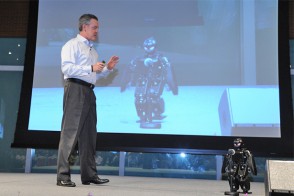
At the MCI Workplan Seminar, IDA’s Executive Deputy Chairman, Mr Steve Leonard (pictured above) also shared the vision for “Building Singapore as a Smart Nation underpinned by Data and Analytics”, and how this is supported by IDA’s three key pillars of “Govern, Deliver and Build”. As a governing body and regulator, IDA’s role is to ensure a fair, competitive and open environment for all market players. It also drives cybersecurity efforts to make sure that even as systems and networks become increasingly complex, they remain sturdy and resilient enough to withstand various cyber threats and ensure data protection.
IDA also plays a key role in service delivery to the public sector, ensuring that systems for government are always available to meet citizens’ needs. “There are currently about 1,000 online services that IDA supports, and this is critically important to what we do as an organisation,” said Mr Leonard.
Keeping citizens’ needs in focus, IDA will also continue to build and transform Singapore into a Smart Nation together with partnerships from government agencies, research institutions, institutes of higher education, corporate partners and start-ups. The Jurong Lake District, which test-beds key ideas, concepts and technologies for the Smart Nation, is also an example of how government agencies are working together with start-ups and companies to create useful and innovative apps in the areas of urban mobility, district management and sustainability.
Other areas that IDA is exploring include building a nationwide heterogeneous network (HetNet), developing computational thinking in children, and introducing an accreditation programme to help Singapore-based technology product start-ups to bring their products and services to Government’s attention. “We want to build tech talent and companies. We want to think about building all kinds of things that can advance Singapore as a Smart Nation,” he said.