

Eye2Eye
IDA Chairman shares her views on leadership
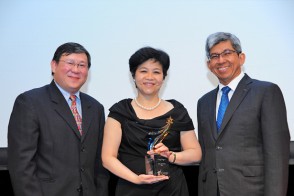
Ms Yong Ying-I (centre, in photo above), Chairman of the Infocomm Development Authority of Singapore (IDA), was inducted into the Singapore Computer Society’s (SCS) Hall of Fame during its Gala Dinner and IT Leader Awards ceremony on 21 February. Describing herself as a professional in the business of government, she shares her views on leadership and some of the groundbreaking IT initiatives that she has been involved with.
What are your thoughts on receiving the SCS Hall of Fame Award?
I see this as recognition of IDA’s efforts and relevance in developing Singapore’s infocomm sector rather than for me personally. It is not just about promoting or developing the ICT industry; it is also about ensuring that ICT supports Singapore’s ambition and that ambition changes every 10 years because technology changes very rapidly.
When IDA was first created, it was about the convergence of IT and telecom. Then it moved to the convergence of infocomm and the media. Now it’s the convergence of infocomm, media and data. So staying relevant is always a challenge for the sector, for IDA as an agency and for Singapore as a whole.
You came on board as Chief Executive Officer of the newly-created Infocomm Development Authority of Singapore (IDA) in 1999. What was the experience like and what were some of the challenges you faced then?
I am a career civil servant and I really see myself as a professional in the business of government. In forming IDA, I think the challenge was not so much about going into a new sector like technology because in all my jobs within government, it was always about going into new content areas; it was also about being CEO for the first time. So it was really the leadership challenge with a newly-created agency.
I was grateful for support of the people in the TAS (Telecommunications Authority of Singapore) and the NCB (National Computer Board). The staff of the two organisations recognised that the environment was changing and that the merger made sense. They wanted to make it work and I was extremely grateful for that.
What does it take to lead an organisation like IDA?
I see myself more as a system orchestrator. I look at how I can help different parts of the ecosystem and the different members of the team to work together cohesively, because none of us can do it alone.
Take the Next Gen NBN (Next Generation Nationwide Broadband Network) project for example. We needed people who could do communications regulation. We needed a legal team because there were many legal issues along the way. We had to have people who could structure the business. We needed people who understood operational rollout and engineering because there were engineering challenges to solve. We needed people who understood what the industry needs.
So it’s actually about how you, as a leader, pull the team together and make the team perform better than the sum of its individual parts. That includes knowing what I am good at and what I am not good at. As leaders, we don’t pretend to know things that we don’t know. We have to recognise that we need to find relevant people in each area of work and how we can enable them to perform to the best of their abilities.
What were some of the more challenging or interesting IT initiatives you have been involved with to date?
I’ve already mentioned the Next Generation Nationwide Broadband Network. It was one of the longest-running projects that I had the honour of stewarding – it went through four CEOs in its journey, and it was a turbulent journey. Still, I am very proud that we managed to roll it out and I believe its value has yet to be fully realised. We will see how important it is to have fibre broadband to every home, every bus stop and every street lamp. We will see how valuable it will be to Singapore’s development as a smart city and a smart nation.
Another exciting project was when I was Permanent Secretary for the Ministry of Health (MOH) and helped drive the building of the National Electronic Health Record (NEHR) system. We are one of the few countries that have succeeded in doing this. It involved pulling together a large number of people – a huge team of IT professionals, doctors, allied healthcare professionals such as physiotherapists and counsellors, people from the government sector, people from the long-term care sector, community hospitals and eventually the GP (general practitioners) community, many of whom were still in the manual era.
Behind the scenes, it involved quite massive organisational restructuring. We restructured the IT teams of the public sector hospitals into one company. They all came together under one entity called Integrated Health Information Systems, which is owned by MOH. With an integrated team across multiple hospitals, they were able to coordinate a lot better and it allowed us to ensure that data could be shared across hospital systems efficiently.
The restructuring may have been difficult but it enabled us to create the NEHR system that clearly benefits patients. In the area of chronic disease for example, patients are now able to take blood tests and check their blood sugar level at a polyclinic or at their own GP. The GP, if he is taking part in the system, can pull out records of your previous blood tests and he will be able to monitor your blood sugar level over time. For people who are diabetic or borderline diabetic, this makes a huge difference. It will help you to manage your health much better. At the end of the day, it is always about helping to serve our citizens better.
What are some of the challenges that lie ahead for the IDA?
A big part of our job is to envisage the future, to see what is happening elsewhere in the world, and to put the next-generation infrastructure in place so that various parties can start to think about new services and opportunities that are possible with the connectivity.
One area that IDA is looking into is the Internet of Things. For example, we could have street lights that are dimmed when there is no traffic, but will turn themselves on when sensors tell them that traffic is approaching. Or there could be sensors in rubbish bins to inform cleaning contractors when they are full, and save them time and manpower. We can’t anticipate everything up front, but we see a lot of future opportunities.
We will also continue to encourage innovation. One of the challenges is how can we encourage the local industry to develop new services that we can sell to the world. For us at IDA, we are always looking at what are the new things that we might be able to champion and help develop to keep Singapore ahead.
We are always moving into uncharted territory – whether it was the liberalisation of the telecoms industry, or looking at digital media and then social media when it first arrived. Today every Ministry has a Facebook page but getting started was quite scary. Every new thing seems a bit daunting at first, but it’s about how we, as a whole community, move into new areas. ICT is a fun area because there are always new ideas that come along. Every week there is a new idea and not every idea works, but it is fun to explore.
Roll of Honour
The 18th Singapore Computer Society (SCS) IT Leader Awards were presented by Dr Yaacob Ibrahim, Minister for Communications and Information, at the SCS Gala Dinner on 21 February. The four individuals who were honoured included:
IT Leader of the Year
Ms Rosina Howe, Group Director, Innovation and InfoComm Technology, Land Transport Authority
Hall of Fame
Ms Yong Ying-I, Chairman, Infocomm Development Authority of Singapore
Young Professional of the Year
Mr Nicholas Chan, Founder of Azione Capital and Managing Director, Fredrik Marine IT Services
IT Youth
Mr Tay Wei Kiat, Co-Founder of Oompr! Pte Ltd