

eGov & Sectors
Tapping the mobile potential for diabetes management
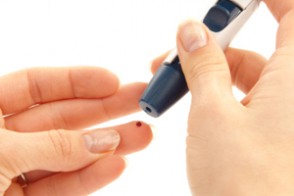
In a boost for diabetes management in Singapore, a new mobile application has been developed to help type 2 diabetes patients who are new to insulin therapy.
The app SGH Diabetes Pal, which was developed by the Singapore General Hospital (SGH) Department of Endocrinology and Integrated Health Information Systems (IHiS), will inform users of the amount of insulin to be injected at the appropriate time. This gives patients the confidence to self-adjust insulin dosage without doctor’s supervision as delayed dosage adjustment may result in the persistence of high sugar levels, possibly leading to serious diabetic complications.
“As part of the Academic Healthcare Cluster, we are always looking at innovative ways to improve patient empowerment and clinical outcomes. The SGH Diabetes Pal is an example of how we leverage on technology to achieve that goal,” said Dr Bee Yong Mong, Director, Diabetes Centre and Consultant, Department of Endocrinology, SGH.
To study if the app can help patients achieve good glycaemic control (control over blood sugar levels), SGH and Duke-NUS Graduate Medical School are conducting a study to determine its effectiveness. This is the first such clinical trial involving mobile apps in a hospital setting.
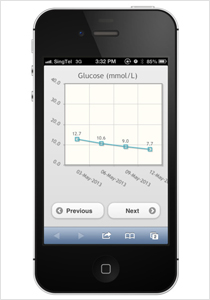
Graphs generated from the patient’s daily glucose readings allow him to see his progress in managing his diabetes.
“This study can potentially change current practices and improve the clinical understanding of diabetes management given the pervasiveness and simplicity of mobile apps,” said Dr Bee, who is also the site-Principal Investigator of the study.
A total of 80 patients who are new to insulin therapy will be recruited for the randomised controlled trial and be put on the 24-week study. They will be divided into two groups and receive individual counselling on all aspects of insulin treatment but only one group will be given access to the SGH Diabetes Pal.
Patients using the SGH Diabetes Pal will set the mobile app to remind them daily about testing their blood sugar level before breakfast. They will then enter the readings into the app and based on the data entered and the patients’ prescribed treatment plan, the app will prompt them on the dosage of insulin injection they need to administer to achieve optimum blood sugar levels. The app will also automatically generate graphs from the daily readings, so that patients can easily see their progress in managing their diabetes.
Meanwhile, the administration function of the mobile web app enables doctors and healthcare staff to remotely monitor the patient’s progress and hypoglycaemic episodes. They can quickly intervene and modify his treatment plan, or communicate with him over the phone, between his clinic visits.
At the end of the study, the change in glycaemic control between both groups will be compared.
The development of SGH Diabetes Pal is part of an effort by IHiS and public hospitals to leverage the high penetration of smart phones in Singapore – and its growing use among the elderly – to reach out beyond hospital walls and deliver care to elderly with chronic diseases within the community, said Dr Chong Yoke Sin, Chief Executive Officer, IHiS. “This study will guide us on how to further employ mobile technologies to transform healthcare where there is partnership between the patient and doctor in managing the patient’s health.”