

eGov & Sectors
Saving Planet Earth
“It is 2092, and Earth has been infested with Pollutations (Pollution mutations). In a desperate attempt to reclaim their habitat, humans created R.E.C (Reconstructive Engineering Cyber-tronics), a robot capable of creating other robots using waste. Playing REC, you must defend the Earth against the Pollutations by building your own army, and clearing the waste to ensure continuity of life on earth.”
This was the storyline behind a game app that allows players to earn points and in-game perks when they recycle waste items in real life. Developed by Team Botscan, it was one of the runners-up in the National Environment Agency’s (NEA) second Clean and Green Hackathon in November, which saw a total of 130 participants producing 15 original environment-related prototypes in 48 hours.
The Hackathon is aimed at encouraging the use of ready data to co-create solutions to environmental challenges in areas such as air quality, dengue, public cleanliness and recycling, and to foster a greater sense of ownership over the environment.
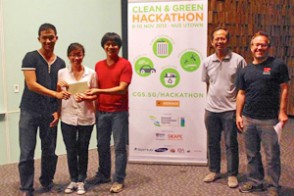
Mr Khor Zi Jian (third from left in picture above) of Botscan said the idea for the app came from seeing the very low recycling rates for plastics and the failure of many recycling efforts to produce any tangible results. “For recycling other materials, post-trash processing is possible. However, for plastics which are largely inert, it is not possible to use magnetism, weight or diffusion to segregate them from the rest of the trash,” he said.
The team decided to come up with an innovative way to change peoples’ behaviour, so that recycling is done at the point of disposal.
By studying other alternate reality games, it also realised that gamification only works if the game and the reality (in this case the physical action of segregating plastic items during disposal) are not only in sync, but also integrated through a compelling storyline. The app is thus being developed such that every plastic bottle that is recycled will be picked up by a sensor, geo-tagged and translated into materials that the player can use within the game. “Together, through the in-game experience and real life actions of people, we are then able to shape and inculcate recycling habits,” said Mr Khor.
Like Botscan, Team Recycle Bots, the overall winner of the Hackathon, realised from household statistics that the plastics recycling rate was low. It also carried out its own survey which found that there was a lack of knowledge as to which materials could be recycled.
To address this, the team created a smart recycling bin which detects different sound frequencies when different materials are dropped, letting the user know if the right materials are being disposed of in the right place. For example, a blue light would come on if the right material was deposited, and a red light would come on for a wrong one.
“We did this because we realised that knowledge on what can and cannot be recycled is lacking and there is confusion on mixed material objects like files with metal clips, said Mr Keith Teo of Recycle Bots. “We also wanted our design to change mindsets towards waste and recycling, making it more of a lifestyle habit, and we hope the feedback mechanism will make recycling the right materials more intuitive in the near future.”
Recycle Bots also won the StarHub Challenge for the most feasible and potentially impactful idea to boost recycling in Singapore.
Still on the subject of bins, another runner-up, Team Bin Cleaner, developed an app that uses Near Field Communications (NFC) technology tags to help the public notify cleaning companies when rubbish bins are filled. With the solution, users who chance upon a bin that is full will just have to tap on a particular spot of the bin which contains the NFC chip. When this happens, a message will be sent to the nearest cleaning company, to alert them to clear the bin. Users are also given points which they can use to redeem rewards, to encourage them to provide feedback on the bins.
Following on the success of the first NEA Hackathon in April this year, the latest event saw an unprecedented 127 datasets made available from agencies such as the Infocomm Development Authority of Singapore and the Singapore Land Authority, an increase from the previous 89 datasets. The number of participating organisations also grew three-fold to 18, with private sector partners such as Samsung, StarHub, SAP, Amazon and Microsoft also offering technical expertise to the participants.
NEA’s Chief Executive Officer Mr Ronnie Tay said, “Given the pervasiveness of smart devices and mobile technology in Singapore, this Hackathon provides participants a platform to realise their ideas by leveraging on available public data and commercial tools and expertise to find solutions to improve the environment we live in. I hope this ground-up initiative will be a catalyst for more community-led initiatives in generating solutions to safeguarding our environment.”