

eGov & Sectors
Masterplan explores HetNet, mobile medical

A computer, camcorder, video player, radio and an alarm clock. Through convergence, these once-separate devices can now be found on a single smartphone that fits in the palm of your hand.
The convergence of the infocomm and media (ICM) landscapes continues to present new possibilities that form the backdrop for a single, integrated Masterplan for Singapore’s infocomm and media (ICM) sectors.
“The goal of the Masterplan is to establish Singapore as a Smart Nation that leads the world in harnessing ICM, and that nurtures innovative talent and enterprises,” explained Minister of Communications and Information Mr Yaacob Ibrahim at the Committee of Supply Debate on 10 March. “This can bring about economic growth and social cohesion, improve the quality of life for Singaporeans, and achieve sustainable and quality growth for our ICM sectors.”
He offered a sneak peek into this upcoming world with a sample of the key ideas from the 10-year integrated Infocomm Media Masterplan to be launched next year.
Connecting between wireless networks seamlessly
Among the ideas mooted by the private sector-led Steering Committee that is spearheading the development of the Masterplan is a nationwide heterogeneous network (HetNet) to provide mobile users the high-quality infrastructure that the Next Generation Nationwide Broadband Network has given fixed-line users.
“Today, mobile users are able to operate and access data services across different wireless networks such as cellular and Wi-Fi. However, resources such as spectrum may not be optimally used to serve diverse user demands, noted Dr Yaacob.
“In a HetNet, operators will be able to achieve better management of traffic in their wireless networks. Users will be able to connect more seamlessly and operate their devices across different wireless networks such as cellular and Wi-Fi. Their devices will also connect to and utilise the best available network within range.
While the industry and public will be consulted about the feasibility and potential application of the idea, Singapore could be one of the first countries to adopt this progressive solution on a nationwide scale.
Home-based healthcare
Tedious waits at hospitals and clinics to get check-ups could be cut down by harnessing ICM and sensors.
“Sensors can help stable chronic disease patients self-monitor their conditions in the comfort of their homes, and receive healthcare services only when necessary,” said Dr Yaacob.
For example, floor mats embedded with sensors can help patients regularly monitor their weight, and sudden weight fluctuations could indicate fluid retention from renal or cardiac failure. In the event that this is caused by a patient’s failure to take their medication regularly, the sensors will give caregivers a heads up, allowing them to intervene and prevent the patient’s condition from worsening, possibly avoiding a costly hospital stay.
Given the future of an aging population, the right-siting of care and “ageing-in-place” via ICM would be valuable to both patients and their caregivers.
A survey has found that three in four Singaporean seniors already use digital technology to help manage their health.
“The openness of our seniors to use technology for their healthcare needs, coupled with the probability of sensors becoming more unobtrusive and less costly, can facilitate the widespread adoption of sensors-enabled home-based healthcare for chronic diseases,” said Dr Yaacob, adding that the technology need not be confined to homes. “Patients with chronic diseases can also potentially be cared for at day-care centres and step-down care facilities. So the social sector also stands to benefit from such innovations.”
Computational thinking for children
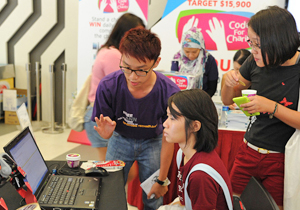
Events like Code for Charity let students pick up fundamental programming concepts in a more casual and enjoyable way.
The Singapore of the future will require the skills to match the increased application of ICM.
“Our children will also need to be more familiar with computational thinking as it becomes an increasingly essential part of our lives and careers,” said Dr Yaacob. “Apart from the infocomm sector, jobs such as animators, visual effects artists, and games developers in the media sector also require our talent to have both creative flair and computational skills.”
In view of its growing importance, the IMM steering committee is therefore proposing to develop computational thinking as a national capability.
Through “CODE@SG”, coding and computational thinking will be introduced through a combination of infocomm clubs, competitions, and enrichment programmes. This will let students pick up fundamental programming concepts in a more casual, and enjoyable way.
“We are also looking into revamping infocomm clubs in schools,” said Dr Yaacob. “We can do this by developing a platform to ‘gamify’ learning, and increase interest levels in computational thinking. With such changes, we aim to increase our engagement with students, and promote infocomm as a highly desirable career choice.”
Potential of data analytics
Dr Yaacob pointed out that work on the Masterplan is ongoing. A consultation document elaborating key ideas will be published later in March. The ideas that represent new directions will require serious discussions as to their feasibility and potential.
One idea that is already underway is data analytics, which has tremendous potential in the business of better governance.
“We can rely on data analytics to develop better policies and programmes for our people. It allows us to spot trends and improve service planning, including in the social sector,” said Dr Yaacob. “Recently, we also expanded our Data Sciences Group at IDA to build deeper domain expertise, and lead our efforts to grow our data analytics capabilities. We will be working closely with other agencies to identify and work on projects that can make use of this new capability.”
These revolutionary possibilities are not the end of the story. Dr Yaacob promised that the Steering Committee is open to new ideas, and will revise and pilot new programmes and schemes over the year to assess their feasibility for inclusion into the Masterplan.