

eGov & Sectors
CGH achieves global benchmark for use of IT
Changi General Hospital (CGH) has achieved a global benchmark for the use of advanced IT to improve patient care. The HIMSS EMRAM Stage 6 achievement plaque was presented to CGH Chief Medical Information Officer Dr Goh Min Liong and IHiS Chief Information Officer for Changi General Hospital & Eastern Health Alliance Ms Phyllis Yap at the inaugural HIMSS Digital Healthcare Week in Singapore on 21 October.
The HIMSS Electronic Medical Record Adoption Model (EMRAM) is a global standard that measures the use of technology to transform healthcare to improve patient safety, care quality and efficiency. It is an eight-stage process that allows hospitals to analyse their level of electronic medical record (EMR) adoption, and track their progress against other healthcare organisations, to reach Stage 7 for full roll-out of an advanced paperless electronic patient record environment.
CGH and Integrated Health Information Systems (IHiS) – the Health Ministry’s IT arm – achieved Stage 6 in the benchmark, on a scale of 0 to 7. This ranks CGH among hospitals with the most advanced clinical technologies worldwide Changi General Hospital (CGH) has achieved a global benchmark for the use of advanced IT to improve patient care. The HIMSS EMRAM Stage 6 achievement plaque was presented to CGH Chief Medical Information Officer Dr Goh Min Liong and IHiS Chief Information Officer for Changi General Hospital & Eastern Health Alliance Ms Phyllis Yap at the inaugural HIMSS Digital Healthcare Week in Singapore on 21 October.
The HIMSS Electronic Medical Record Adoption Model (EMRAM) is a global standard that measures the use of technology to transform healthcare to improve patient safety, care quality and efficiency. It is an eight-stage process that allows hospitals to analyse their level of electronic medical record (EMR) adoption, and track their progress against other healthcare organisations, to reach Stage 7 for full roll-out of an advanced paperless electronic patient record environment.
CGH and Integrated Health Information Systems (IHiS) – the Health Ministry’s IT arm – achieved Stage 6 in the benchmark, on a scale of 0 to 7. This ranks CGH among hospitals with the most advanced clinical technologies worldwide.
“Singapore continues to have the highest number of public hospitals with HIMSS Stage 6 in Asia Pacific,” said Mr Steven Yeo, General Manager of HIMSS Analytics Asia Pacific & Middle East. “At Q3 2013 only 2.5 per cent of 613 hospitals in Asia Pacific tracked by HIMSS have Stage 6 or 7 capabilities. Across US, Canada, Europe, Middle East and Asia Pacific, just 8.5 per cent of over 8,300 hospitals tracked by HIMSS have achieved these benchmarks.
In 2011, Singapore’s KK Women’s and Children’s Hospital, National University Hospital, Singapore General Hospital and Tan Tock Seng Hospital became the first public hospitals in Asia Pacific to achieve the benchmark.
“HIMSS Stage 6 is an outstanding achievement that recognises CGH and IHiS’ exemplary efforts and commitment to harnessing technology to provide patient-centric and cost-effective care,” said Mr Yeo.
CGH Chief Executive Officer, Dr Lee Chien Earn, said the hospital’s aim is to transform the way its people work and enable healthcare professionals and providers to deliver safer, better and more personalised care through the wise use of IT.
“IT is an essential component of healthcare, enabling simple administrative tasks to complex medical procedures,” he said. “This award is a testament to the hard work and creativity of our staff and partners to come up with innovative processes and solutions to derive the optimal benefit in terms of care outcomes, productivity and staff satisfaction from our investment in IT.”
IHiS, which manages IT systems at all public healthcare institutions, played a pivotal role in helping CGH to achieve the benchmark. Its Chief Executive Officer, Dr Chong Yoke Sin, said, “The HIMSS global benchmark highlights our hospitals’ focused efforts to harness IT to overcome Singapore’s healthcare challenges. IT is being used to transform clinical processes and maximise staff productivity to provide quality and affordable care to our increasing numbers of elderly ill.”
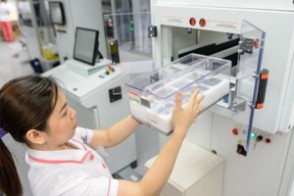
In working towards Stage 6, CGH and IHiS staff explored creative solutions to significantly improve clinical efficiencies. For example, CGH was one of the first hospitals in the region to deploy QR code technology instead of barcodes in its medication management process. QR codes can hold several hundred times the information in conventional barcodes vertically and horizontally. They can also be scanned more quickly and be printed on narrow surfaces. This allows more information to be stored and scanned in labels, and thus more checks to ensure patient safety.
Today, IHiS has integrated IT systems at all public hospitals, specialty centres and polyclinics. Doctors and healthcare staff directly enter electronic orders into computers, access instantly patients’ medical records across institutions, and view radiology images and lab test results immediately when they are known.
IHiS is also expanding the advanced IT environment beyond the hospital walls to provide tele-health solutions at community facilities, nursing homes, and patients’ homes. These include doctor tele-consultations, and healthcare staff monitoring and guiding patients through remote monitoring devices, tele-care hubs and mobile applications.