

eGov & Sectors
Bringing geospatial adoption to the next level
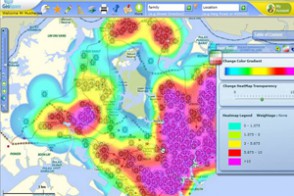
The Infocomm Development Authority of Singapore (IDA) is aiming to bring private-sector use of geospatial technologies to the next level by exploring the potential benefits of geospatial analysis and predictive modelling to businesses.
Over the past few years, there has been a growing number of visualisation applications and mashups which involve the use of geospatial technologies to provide data with a location context, said Mr Terence Tan, Assistant Director of Land Management, Transport & Logistics, IDA. There has also been an increase in the use of geospatial applications to enhance business operations, for example, through route optimisation or track and trace applications.
Mr Tan was speaking at an Industry Networking Session for IDA’s geospatial programme i-Singapore, which was held at IDA on 1 July. During the session, two companies also shared their experiences with the adoption of geospatial applications.

Mr Xavier Quek, Business Development Manager of food distributor Brilliant Marketing Pte Ltd, spoke about how the use of a geospatially-enabled distribution management system enabled the company to reduce its out-of-stock situations by 30 per cent and raise its merchandisers’ visitation productivity by up to 35 per cent.
Client software installed in the merchandisers’ mobile devices provides real-time, location-based information on sales visits and allows the merchandisers to send updates on stock levels so that the relevant products can be replenished. The system also captures information such as the time taken to travel between outlets. With this, routes can be modified to become more efficient, and outlets are also less likely to be missed in a sales visitation cycle.
In the second example, SysEng (S) Pte Ltd, which provides real-time water monitoring solutions, makes use of a mobile workforce management system to optimise the deployment and routing of its ground crew, said General Manager Mr Choo Chun Keong. The crew visits various sensor locations to carry out tasks such as maintenance, calibration and housekeeping. Information gathered at each site (for example, readings and photographs taken, or other relevant notes made) are geo-tagged automatically with a time and location stamp. This makes it easy for information to be consolidated, and allows client reports to be generated within minutes instead of hours.
While these applications will continue to gain traction and remain important, the focus for i-Singapore this year will be to encourage even more sophisticated use of geospatial technologies among businesses, said Mr Tan of IDA. An example is the use of geospatial analysis and predictive modelling for business planning.
Dr Kam Tin Seong, Associate Professor of information Systems (Practice), at the School of Information Systems, Singapore Management University (SMU), said geospatial analytics involves integrating spatially-enabled data collected from various sources, analysing these datasets using appropriate geospatial analytics techniques and communicating the results of the analysis to management in the form of easy-to-understand, actionable information, to facilitate decision-making.
Dr Kam, who is also the Faculty Head of the SMU-SAS Advanced Analytics Lab, emphasised that “geospatially-enabled data” was not the same as data from a geographical information system (GIS). A lot of business data out there, for example customer data, does not have direct spatial properties. However, if one were to include, say, a postal code, the data would immediately have a geospatial dimension, he explained.
In geospatial analysis, therefore, the focus is on analysing geospatial-enabled data to derive process information about the customer and help businesses address questions such as: Where does my mass market tend to concentrate? Where does my niche market tend to concentrate?
To expose businesses and users to the potential benefits of geospatial analytics and predictive modelling, some analytics services and tools are being made available via OneMap , the common mapping platform for government agencies to share location-based information with the public.
An example is PopulationQuery, a service on OneMap which facilitates queries and analysis of population-related data. The service, collaboration between Singapore Land Authority and the Department of Statistics is built on a repository of population data from 2000 to 2012 and includes parameters such as age group, ethnic group, occupation, educational qualification, type of dwelling etc.
Another location intelligence tool available on OneMap is ShowNearby Analytics, which gives businesses insights into potential traffic at a given location and helps them assess the effectiveness of their marketing strategies.
Under the i-Singapore programme, IDA is also reaching out to businesses and the IT industry to solicit proposals for the development and deployment of geospatial business applications for adoption by companies.
For more information, please email [email protected] .